What Is a Good Canvas Size for Digital Art?
How to pick a Sheet Size for your ArtRage Paintings
Choosing a canvas size is one of those horrible math-filled topics that are terrifying and mysterious the outset time y'all effort and do digital art, or showtime because press your art. It is important to make sure that you practice non starting time with a canvas that is too small-scale because y'all cannot make it larger after without losing quality. Only what is "too small"? How large can you go? This comprehensive guide should help you spring into the confusing globe of pixels, printing and canvas size guesstimates. You don't demand to understand information technology all, but it's a practiced idea to understand it a little!
Quick Reference
Pixel sizes:
- Employ around 500-1000 pixels for little easy paintings where the concluding quality doesn't matter (e.thousand. sketches, stuff yous're simply going to post online)
- Utilize 2000-5000 pixels a side for the stuff you might quite like to print, or want to turn into a Proper Painting and need some decent detail for.
- Utilise 5000-15,000 for the Really Detailed Stuff and the things that yous know you need to print in super high quality or at poster size or higher up.
- Use fifteen,000 and up if you have a very fast computer and are obsessed with tiny details or are involved in some kind of super project.
Pixels/Inch (DPI/PPI)
- Ignore it entirely and base your canvass sizes on the pixel guidelines to a higher place
- Or… if you actually want to empathize what's going on, or demand a very specific print result, play around with the calculations and changing the final print size until y'all go an idea of how big your ideal printing size translates into pixels.
- In which instance, employ 150-300 pixels/inch, unless you lot accept very specific instructions from your printer nigh what it is technically capable of/y'all know your specific printing plans crave something else.
Working larger than your hardware likes
- Use scripts
- You can create tool sizes up to 500% in the desktop software by property SHIFT and dragging left/correct or by clicking on the size and typing in the number you want.
- Beginning small and expand the sheet every bit you work to go along the retentivity usage controllable.
- Merge layers every bit you go and avoid the memory-suck tools (watercolor, transform)
- Paint sections/objects in another document and copy the concluding result in equally a single layer if you demand to go along layers as an option.
Maximum Canvas Sizes
The desktop versions have unlimited sail sizes, limited simply by your reckoner retention. The mobile apps accept capped sizes, due to the express retentivity (RAM) in phones and tablets.
- ArtRage 4.5 and Lite have 64-bit support so can use unlimited RAM memory.
- Earlier versions can employ upward to 4GB RAM so usually can just make it to 8000-10000 pixels..
- Android, ArtRage Touch and iPad users can create canvases up to 2048 x 2048 pixels
- iPad one users are limited to 1400 x 1400
- iPad Pro 11″ users can create canvases up to 4096 x 4096 pixels.
- iPhone users are capped at 960 x 640
- ArtRage Complimentary uses 'whatever your screen resolution is'.
You can set your canvas size in ArtRage in:
- The New Canvass screen (all versions of ArtRage)
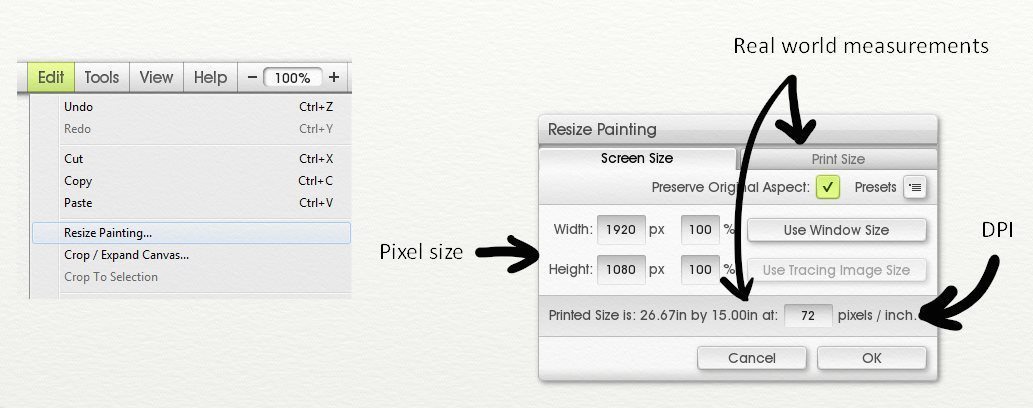
- The Edit > Resize Painting and Edit > Crop/Expand Canvas card options (desktop versions of ArtRage only, resizing is too memory intensive for the mobile versions).
The Longer and More Detailed Explanations For Everything
What Are Pixels?
Pixels are the units of the internet. Every paradigm on your screen is made upwards out of many, many trivial pixel dots, and this is what you are 'painting' with.
Every digital paradigm contains a specific number of pixels, and the size of your canvass is literally only picking how many pixels yous want to first with. The bigger your image, the more detail you can add, and the larger you lot can print. Nevertheless, you don't actually need a very big canvas size if you but desire to share your work online. Withal, the bigger your image, the more memory information technology uses and the slower things might get (this is why the mobile apps have capped canvas sizes).
Impress size is an estimate based on your pixel size (the 'real' size of the paradigm) and the 'Pixels/Inch' measurement (too known as DPI/PPI), which tells the printer how detailed the concluding image should be. But you lot don't demand to worry virtually that unless you are trying to go a really specific press result.
Picking A Size
When selecting a size, consider the following things:
Practise you demand to impress it? Calculate the largest size and exact aspect ratio that you lot'll need and use that so yous don't have to worry going forrard.
I'm serious well-nigh the aspect ratio, by the way; you tin can usually fudge the print quality a bit (paintings are blurrier that photos by default then yous don't need to exist as picky), but if your actual width:length ratio is wrong? Yous may have to make some painful cropping decisions as well-nigh print places simply deport a specific range of paper sizes.
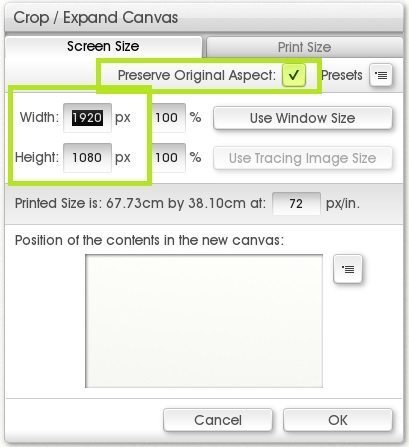
Don't forget to untick 'Preserve Aspect Ratio' as that will force your width and summit to stay the aforementioned relative sizes, so you lot'll exist stuck in an endless update loop.
Does it demand to be loftier quality and detailed? Probably 5000-15,000. Y'all'll need to effigy this out every bit yous get, but you tin resize your sheet as y'all work, and y'all may find yous don't like working at large sizes (as it affect tool size and computer speed).
Or is information technology merely a quick sketchy paradigm for the internet or a lowish quality web graphic? Choice a smallish basic size between chiliad-4000 pixels and don't worry nearly it. You lot tin can go fifty-fifty smaller, but usually you don't need to.
I by and large draw web graphics at twice their last size, which gives me some flexibility if I desire to ingather information technology or change the attribute ratio and means I don't take to worry nigh quality loss for the fine details.
Bigger is always safer, every bit y'all can scale downwardly equally needed, just you lot might not like working at large sizes, so information technology's a personal decision. I usually work at effectually 3000-5000 pixels a side, unless I know I will need a larger epitome for a specific result (e.g. I tin can make a minor poster out of that, but the quality might not be bully. On the other hand, I regularly sold A3 posters and even created an A2 poster out of a 3000 pixel image one time and they sold just fine!).
If you are uploading your work to an online print on need website, you may discover that their system requires some very specific sizes and DPI settings. This is to avoid people uploading truly unsuitable images, but if yous are confident that your image will be fine and doesn't demand to be the size they are requiring, simply artificially resize your canvas upwards earlier uploading. How much you lot can get abroad with this is going to vary on a case by case basis, but ArtRage paintings are commonly soft edged and can be upsized nearly 30% before you lot see noticeable issues. But yous will always see some quality loss with any resizing upward, because the figurer has to make full in empty pixel space.
How to Cull and Set the Print Size
Set the zoom level to 100% in ArtRage. This will show you how big the canvass actuallyis relative to your screen size. Information technology's very piece of cake to lose sight of the bodily size when zooming in and out to work ;D
Practise the Pixels Per Inch x Pixel calculation: This is the horrible mathy bit that makes people'southward heads injure. If you need 300 pixels for each inch, what does 3000 pixels carve up downward into? (X inches ;D).
You tin also ignore the nasty math and just toggle back and forth between the canvas size tabs in ArtRage, which calculates this for you lot.
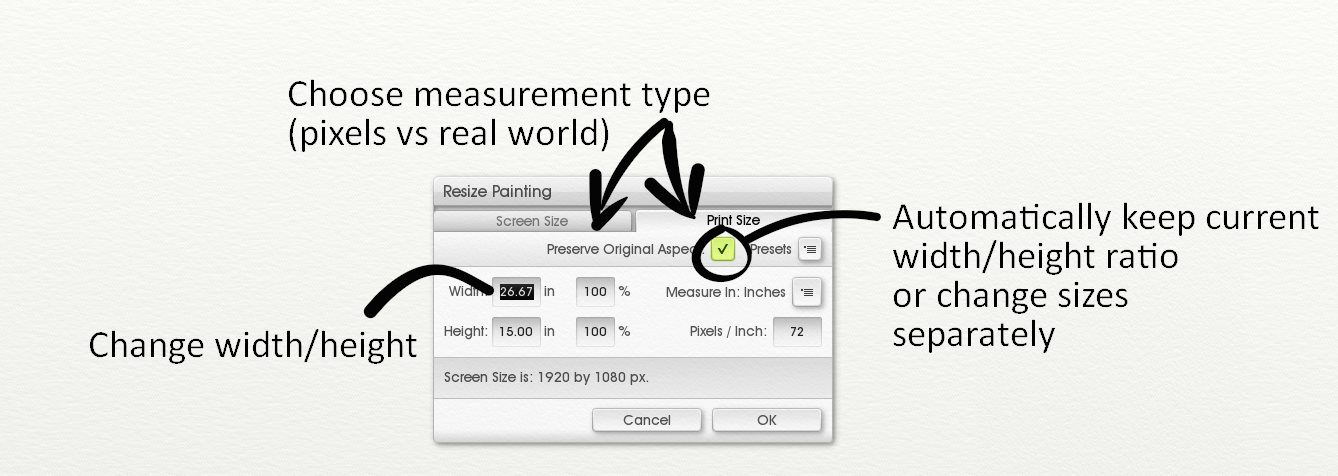
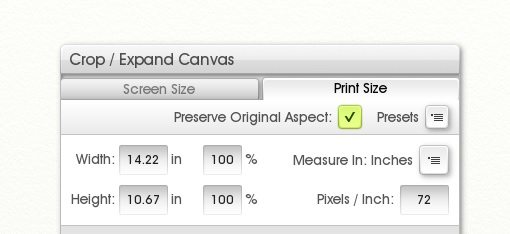
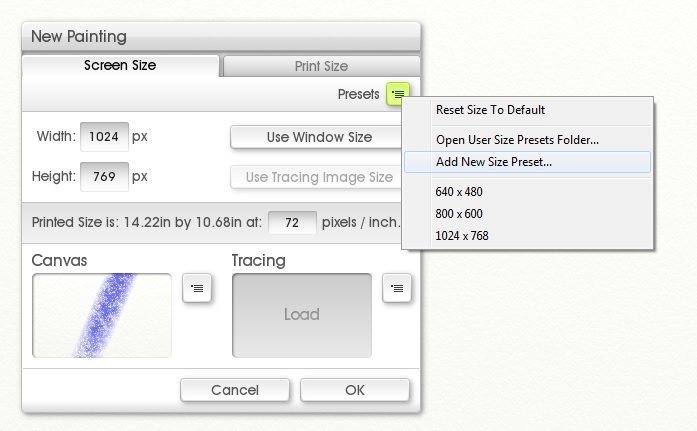
Screen Size uses pixels. Impress Size lets you ready the units (mm, cm or inches), but the Pixels/Inch measurement is very of import here, because it is calculating the size based on your pixels.
The pixel size is the 'existent' size of your file, so nosotros highly, highly recommend getting used to what the numbers mean. A 5000 x x,000 pixel canvas (which is large for most purposes) may be much college than y'all need, or it may be simply right.
I don't understand, explain the printing size stuff a bit more?
Calculating the 'perfect' print size is a topic that tends to cause a lot of argument among 'real' artists (and photographers), for whom information technology is very important to get exactly the right result, but the easiest fashion to estimate the size for now is to switch over to the 'Print Size' tab in the canvass size screen (meet moving-picture show).
- Figure out how large you lot want to be *able* to print in inches/centimetres and put that in.
- Decide what Pixels/Inch measurement yous desire.
- Then switch tabs over again to come across how many pixels that comes out to, and use that equally a full general guideline.
Once you know what pixel size you like working at, you can ignore the 'Print Size' tab and the Pixels/Inch measurement entirely, and just set those when you go to actually print something.
How to choose Pixels/Inch (DPI or PPI)
DPI = dots per inch, or how many ink drops. PPI = pixels per inch. These days they're essentially the aforementioned thing and used interchangeably.
Your choice of pixels/inch is realistically between 72-450.
72 is 'screen resolution' and generally not great. 450 is super high quality overkill that most printers can't fifty-fifty manage. 150-300 is a good range for fine art printing.
Note:
The 'recommended' DPI/PPI amount is usually set by a) photographers or b) Very Serious Artists. These people demand very, very high pixels per inch because photographs do not expect adept when slightly fuzzy and Serious Artists volition be printing out very high quality images on expensive paper and needing to consider everything down to the blazon of ink.
You lot probably do not need that. Y'all tin can probably get away with 100 pixels per inch. The just times you need to worry a lot about the exact pixels per inch is if you lot:
- take a very 'crisp' drawing with lots of sharp edges, rather than thick paint and shadows and soft blending, which volition show blurriness a lot more clearly
- are press very small loftier quality images that people will be looking at very closely (e.g. greeting cards)
- are printing very Important Serious Art and know yous are working with a fancy artist printer that tin can actually impress very high quality
If you're not sure what 'likewise low but just slightly' will look similar in existent life, pick up some random printed pictures or leaflets, hold them upwards to your olfactory organ and try and see if you can really come across any pixels. The cheaper the printing, the more probable you are to run into depression quality graphics! And then hold it at artillery length and take another look – yous'll frequently discover that the pixelated images look fine if y'all aren't rubbing your nose on them, and then you have a lot more leeway when creating very large posters.
Or merely randomly print out some test images on estimator paper. Your home printer will most e'er utilise 72 DPI, then information technology's very piece of cake for you to see if that's usable or not.
If yous know yous will want to utilise the same size again, just create a size preset.
Sharing Images Online
Sharing images online is a niggling complicated because every screen is different and websites will brandish everything differently, just most of the time, the actual size you demand will exist far, far smaller than the size you need for printing, so you'll rarely run into quality issues. This can hateful that issues won't show upwardly until yous go to impress!
Your screen resolution is somewhere betwixt 600 and 1920 pixels beyond. That's smaller than the maximum canvas size in our mobile apps (which is 2048×2048 pixels). So yous could easily create a screen size sail using the 'Utilize Window Size' button and non really worry about the quality or size.
Facebook and other social media sites tend to shrink pictures to a standard size that are easy to browse, but aren't always the all-time size for sharing fullsize, detailed, fine art. Facebook shrinks images to effectually 900 pixels wide, so as long as your images are bigger than that, they volition always be full size – for Facebook! – when you upload them.
To detect out the exact size you demand, try downloading an image off the website and then open up it in an paradigm editor or right click on it and have a look at the properties.
Problems With Large Canvas Sizes
The larger your prototype, the more likely you are to come across issues with memory, equally y'all beginning working with a larger and larger file, or the tool sizes may just not scale up enough for your purposes. If you tin can't create a large enough sheet for tool size/workflow/hardware limitation reasons, then yous still take…
Scripts
ArtRage scripts tape your painting process and allow you literally replay the unabridged series of steps later. ArtRage four (desktop) will allow yous to change the resolution (the size of the canvas), so y'all tin can record a painting that is 500×500 pixels wide and replay it at 10,000×10,000 pixels.
- You can record scripts in ArtRage three Studio Pro, Lite & 4 (desktop), Android & iPad.
- You can replay scripts at any size in ArtRage 3 Studio & Studio Pro and ArtRage iv. Yous tin can replay scripts at their original size in ArtRage Light.
- ArtRage's brushes include some random variation, so your scripts may be subtly unlike when you play them back. Most of the time this won't matter, but occasionally you may find it annoying. Canvas texture scale may also affect your strokes.
- Your script may be very large and take a long fourth dimension to replay, but there is an 'accelerate script' option for fast playback.
- You can replay a script as many times as y'all like and create a new painting each time. You can terminate it at any point.
- If you stop recording during the script and forget it turn it dorsum on until you've fabricated a few strokes, this can mess up everything after that.
- Yous tin edit the script files using Notepad or other text editors, just ctrl + f for tool names or create sample scripts to meet what y'all need to look for. But script files are very, very long, and then this is only helpful for 'whoops, I didn't record that I switched tools and information technology thinks I'm using a pencil, I demand to delete the Pencil line' or 'I don't want the reference to testify up, I should delete that block of code'.
- Become more than aid with advanced script editing in the manual or the forums.
Script Recording on Mobile Devices
- Android and iPad: Both the full mobile apps for Android and iPad permit you to record scripts for playing dorsum later on, but you demand to turn 'Record Script' on in the new canvass screen. The script is and so embedded into the painting, and y'all need to export information technology afterward. Yous can consign multiple scripts at different times.
- Go to File > Play/Record Script in the desktop programs.
- Script recording is complicated and memory intensive so yous cannot edit or play them dorsum on mobile devices, only in the desktop programs.
More ArtRage Tutorials
[fp_carousel width="940″ summit="200″ items="5″ num="-ane″ speed="600″ cat="Tutorials" orderby="appointment" post_type="post"]
Also see: Scaling Up Your Mobile ArtRage Artworks For Print
Source: https://www.artrage.com/choose-canvas-size-artrage/
0 Response to "What Is a Good Canvas Size for Digital Art?"
Post a Comment