What Is a Baby Covered in When Born
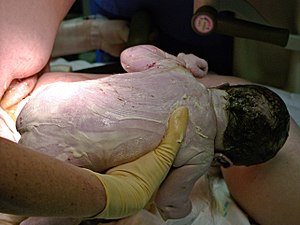
Newborn infant immediately later on birth, covered in vernix
Vernix caseosa, also known as vernix or birthing custard, is the waxy white substance found coating the skin of newborn human babies.[1] It is produced by dedicated cells and is thought to take some protective roles during fetal development and for a few hours afterward nascency.
Etymology [edit]
In Latin, vernix ways varnish and caseosa ways cheesy. The term was outset published in 1846 in the Dunglison Dictionary of Medical Sciences.[1]
In-utero development [edit]
Vernix is produced during a distinct phase of the epidermal development.[2] Around the 21st calendar week of gestation, periderm cells are beingness shed and replaced with stratum corneum; these shedding mix with secretions of sebum by the sebaceous glands to form vernix, which gradually covers the body in an anteroposterior and dorsoventral pattern.[i] [2] [iii] Vernix, in itself, is also believed to help in the germination of stratum corneum.[4] By early third trimester, the process is consummate.[five]
Shortly enough, role of the vernix is emulsified by increasing concentrations of pulmonary surfactants and desiccates, only to be consumed past the fetus; a corresponding increase in amniotic fluid turbidity is noticed.[two]
Characteristics [edit]
Composition [edit]
Vernix has a highly variable makeup just is primarily equanimous of sebum, cells that have sloughed off the fetus'due south pare and shed lanugo hair.[6] Chemically, it is water (80%), lipids (ten%) and proteins (10%).[one] The lipids include ceramides, cholesterol, fat acids, triglycerides, waxes and sterol esters, squalene, and phospholipids;[1] multiple detailed analyses of the polar components have been done.[vii] The poly peptide composition is relatively understudied.[1] Vernix of term infants has more squalene and a higher wax ester to sterol ester ratio than preterm infants.[6]
Morphology [edit]
Vernix is composed of mobile corneocytes embedded in an amorphous lipid matrix.[one] Precise biological mechanisms leading to its formation are poorly understood.[eight]
The cells are polygonal or ovoid in shape, malleable, and lack nuclei; typical thickness is 1-2 µm.[1] Nuclear ghosts are frequently observed and Acid Phosphatase Activity is nonuniform.[1] Keratin filaments build a scaffold like structure which grade a h2o-storage area.[ane] As opposed to stratum corneum, the vernix corneocytes lack desmosomal attachment and the lipid layer is more matted.[nine]
Physical properties [edit]
Vernix is a white viscous cream-similar substance in appearance.[1]
The water is not uniformly distributed throughout, but rather exclusively present in the sponge-similar corneocytes; despite its high water content, vernix is non-polar (due to lipids) and more than vapor-permeable than stratum corneum.[ane] [10] [xi]
Functions [edit]
Vernix appears in all full term infants merely with widely varying body-coverage, while premature and post-mature births generally do non display any.[6] [2] [12]
It is theorized (and observed) to serve several purposes:[one] [two] [10]
- Electrical isolation of the fetus (this affects accurate fECG measurement of fetal heartbeat).[13]
- Waterproofing the peel, whilst in gestation.
- Lubricating the baby's skin, and facilitating easy passage through the birth canal.
- Preventing infections — primarily as a mechanical bulwark and secondarily via the presence of lysozyme, lactoferrin and antimicrobial components in peptide layer.
- Moisturizing the stratum corneum whilst in gestation (and controlled drying in post-partum stage).
- Thermoregulation in mail-partum phase — evidence is mixed.
- Quick healing of epidermal wounds.
- Development of gut, afterward intra-uterine consumption.
Medical uses [edit]
Vernix is used as a reliable site-of-record for measuring cocaine exposure in meaning women.[two] Using vernix for diagnosing uterine rupture and amniotic fluid embolism has been proposed.[2]
Disorders [edit]
Granuloma and peritonitis of vernix accept been observed in Caesarean sections.[two] High volumes of vernix cause Neonatal Aspiration Syndrome.[2]
Other species [edit]
Vernix is idea to be unique to man fetal development; in 2018, vernix-like material was reportedly obtained from pups of Zalophus californianus.[14]
Additional images [edit]
-

Vernix on a newborn's legs and anxiety.
-

Traces of vernix caseosa on a total term newborn.
-

Closeup of baby's face right later on nascency, skin covered in vernix and some claret.
References [edit]
- ^ a b c d e f chiliad h i j m l chiliad Nishijima G, Yoneda M, Hirai T, Takakuwa K, Enomoto T (November 2019). "Biology of the vernix caseosa: A review". The Journal of Obstetrics and Gynaecology Research. 45 (11): 2145–2149. doi:x.1111/jog.14103. PMID 31507021.
- ^ a b c d e f g h i Singh G, Archana G (2008). "Unraveling the mystery of vernix caseosa". Indian Journal of Dermatology. 53 (2): 54–lx. doi:10.4103/0019-5154.41645. PMC2763724. PMID 19881987.
- ^ Moore AL, Marshall CD, Nauta A, Lorenz HP, Longaker MT (2019-01-01). "Affiliate 5 - Scarless Wound Healing: From Experimental Target to Clinical Reality". In Atala A, Lanza R, Mikos AG, Nerem R (eds.). Principles of Regenerative Medicine (3rd ed.). Boston: Academic Printing. pp. 65–92. doi:10.1016/B978-0-12-809880-6.00005-9. ISBN978-0-12-809880-half dozen.
- ^ Hoath SB, Shah KN (2017-01-01). "49 - Physiologic Development of the Pare". In Polin RA, Abman SH, Rowitch DH, Benitz We (eds.). Fetal and Neonatal Physiology (Fifth ed.). Elsevier. pp. 498–514.e4. doi:10.1016/B978-0-323-35214-7.00049-iv. ISBN978-0-323-35214-7.
- ^ Karperien M, Roelen BA, Poelmann RE, Gittenberger-de Groot Air conditioning, Hierck BP, DeRuiter MC, Meijer D, Gibbs South (2015-01-01). "Chapter 3 - Tissue Formation during Embryogenesis". In Blitterswijk CA, De Boer J (eds.). Tissue Engineering (2nd ed.). Oxford: Bookish Press. pp. 67–109. doi:ten.1016/B978-0-12-420145-3.00003-1. ISBN978-0-12-420145-3.
- ^ a b c Schachner LA, Hansen RC (2003). Pediatric dermatology. St. Louis: Mosby. pp. 206–vii. ISBN978-0-323-02611-6.
- ^ Harazim E, Vrkoslav 5, Buděšínský Yard, Harazim P, Svoboda K, Plavka R, et al. (Nov 2018). "O-acylceramides in vernix caseosa". Journal of Lipid Research. 59 (eleven): 2164–2173. doi:10.1194/jlr.M088864. PMC6210899. PMID 30254076.
- ^ Hoath SB, Narendran V, Visscher MO (2011). "Vernix Caseosa and Innate Immunity". Innate Immune System of Skin and Oral Mucosa. John Wiley & Sons, Ltd. pp. 145–169. doi:x.1002/9781118025338.ch8. ISBN978-1-118-02533-viii.
- ^ Rissmann R, Groenink HW, Weerheim AM, Hoath SB, Ponec Chiliad, Bouwstra JA (Baronial 2006). "New insights into ultrastructure, lipid limerick and organization of vernix caseosa". The Journal of Investigative Dermatology. 126 (eight): 1823–33. doi:10.1038/sj.jid.5700305. PMID 16628195.
- ^ a b Hoath, Steven (2003). Neonatal skin : structure and office (two. ed., rev. and expanded. ed.). New York [u.a.]: Dekker. pp. 193–208. ISBN0-8247-0887-3.
- ^ Visscher Thousand, Narendran V (April 2014). "The Ontogeny of Skin". Advances in Wound Intendance. three (4): 291–303. doi:10.1089/wound.2013.0467. PMC3985523. PMID 24761361.
- ^ Sidbury, Robert (2018), "Newborn Skin Evolution", Avery'due south Diseases of the Newborn, Elsevier, pp. 1468–1474.e1, doi:ten.1016/B978-0-323-40139-5.00103-0, ISBN978-0-323-40139-5 , retrieved 2021-01-04
- ^ Chiera Thou, Cerritelli F, Casini A, Barsotti N, Boschiero D, Cavigioli F, et al. (2020). "Middle Rate Variability in the Perinatal Period: A Critical and Conceptual Review". Frontiers in Neuroscience. 14: 561186. doi:10.3389/fnins.2020.561186. PMC7544983. PMID 33071738.
- ^ Wang DH, Ran-Ressler R, St Leger J, Nilson E, Palmer L, Collins R, Brenna JT (May 2018). "Sea Lions Develop Human-like Vernix Caseosa Delivering Branched Fats and Squalene to the GI Tract". Scientific Reports. 8 (i): 7478. Bibcode:2018NatSR...viii.7478W. doi:10.1038/s41598-018-25871-1. PMC5945841. PMID 29748625.
Wikimedia Commons [edit]
What Is a Baby Covered in When Born
Source: https://en.wikipedia.org/wiki/Vernix_caseosa
0 Response to "What Is a Baby Covered in When Born"
Post a Comment